
K House is an Indian restaurant in the centre of Bremen, a city in northern Germany. We rebuilt the brand, the signage, the menus and the Google Business Profile.
A restaurant rarely loses guests at the table. It loses them the moment someone three streets away pulls out a phone and searches for Indian food in Bremen. A business that does not appear in that map result does not exist for that guest, however good the kitchen is.
How a good restaurant stays invisible
K House had already solved the hard part. Authentic Indian street food, high quality, loyal regulars, a location in the city centre.
What was missing was the translation of that quality to the outside. The signage on the building did not do the kitchen justice, the menus had grown rather than been designed, and the Google profile did not show the restaurant that actually sits behind the door. For a business whose guests mostly decide on a phone, that is the most expensive gap there is.
The wider conditions did not help. In 2025, adjusted for inflation, German hospitality recorded its sixth loss-making year in a row, with real revenue 14.8 percent below the pre-crisis year of 2019. For food-led hospitality alone, the gap in the first half of 2025 was 17.4 percent.
What we did for K House
Brand and signage. A rebrand with a visual language that picks up Indian street food without tipping into cliché. Realised physically in an illuminated facade sign and a double-sided backlit projecting sign. The projecting sign is the more important of the two, because it sits perpendicular to the direction of travel and is therefore read from along the street rather than only from directly outside.
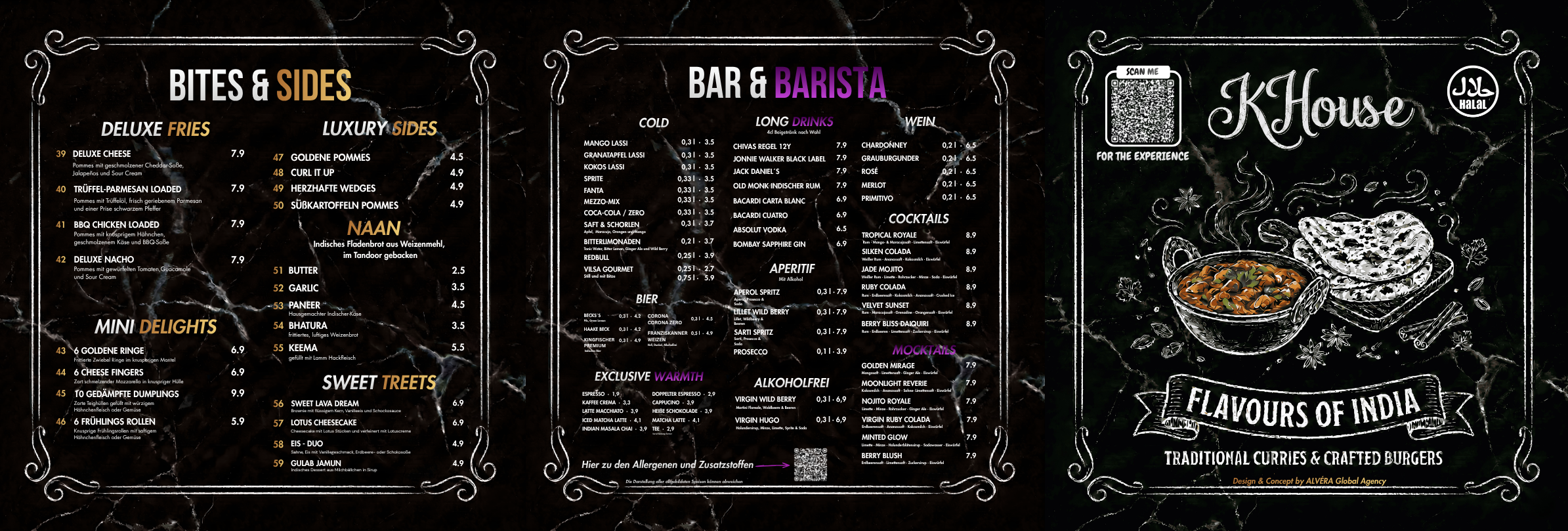
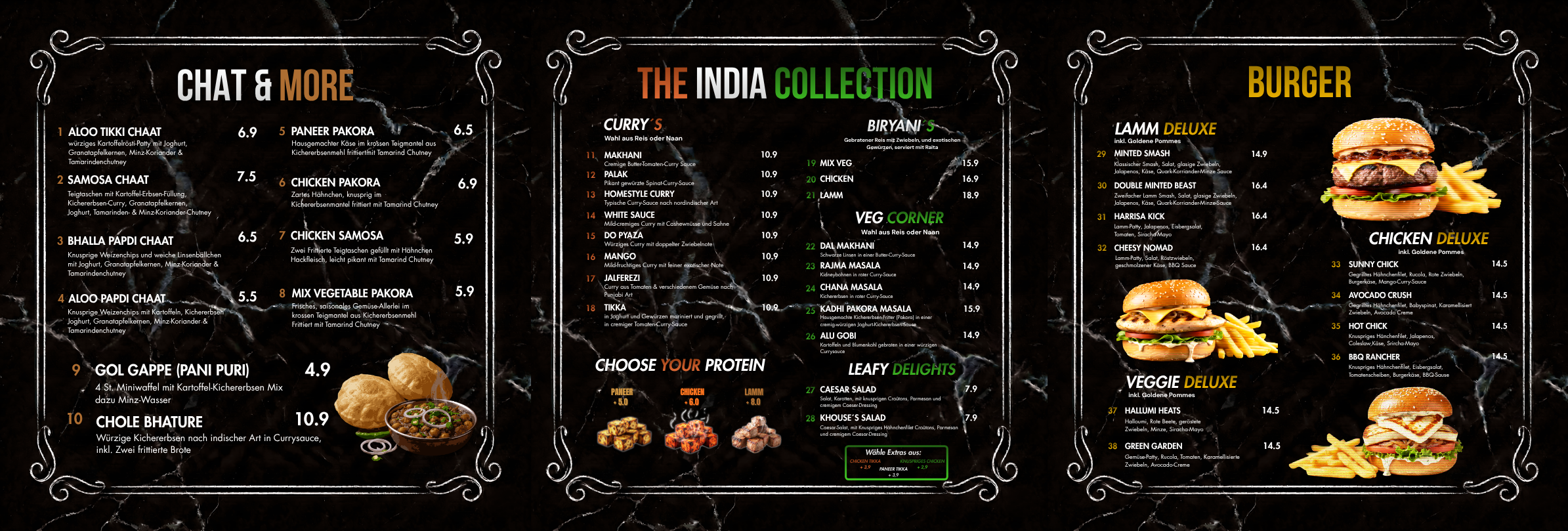
Menus. Not made pretty, but built around legibility and the order sequence. Groups cut so a guest reaches their category quickly, order within each group set deliberately, typography checked for legibility under restaurant lighting.
Google Business Profile. This is where the leverage sat. Every field completed, categories sharpened, structured opening hours, the menu added, high-quality food photography, and a regular posting rhythm established. A profile that does not show the kitchen does not take part in the guest's decision.
Coordinating the sign makers and the printer. Managed from concept through to sign-off on site. The client had one point of contact while we coordinated the trades. That is the invisible part, and it decides whether dimensions, materials and installation actually fit together at the end.
Results
More than 45,000 Maps views over [PERIOD]. Views of the Google profile in map view, not people. The same person can generate several views. Method and period are in the next section.
4.9 stars from 122 Google reviews, as of 3 August 2026, publicly visible.
A consistent identity from the facade to the menu. Facade sign, projecting sign, menu and Google profile all show the same brand.
Why we do not compare this figure to an industry average
The obvious move would be to set the view count against a benchmark. The most widely quoted one comes from BrightLocal and sits at 317 Maps views per month. That would produce an impressive multiple.
We do not use it, because the comparison does not hold. The 317 is an average across every type of local business, from law firms to garages to dentists. Hospitality sits structurally far above that figure, because people constantly search for food nearby and almost never for accountancy nearby. Measuring a restaurant against that blended average produces a number that looks good and says nothing. On top of that, the study dates from before Google My Business was renamed, which makes it several years old.
A meaningful comparison would need Maps views from restaurants of similar size in the same city. That data is not public. So what stands here is the absolute figure with its period and source, and no multiple.
What this means for other hospitality businesses
For most operators the largest unused lever is not that they are missing from Google Maps. It is that their profile does not show what they actually are. Missing photos, incomplete details, no menu, no replies to reviews.
A rebrand is not cosmetic in that situation. The images that end up in the profile come out of the identity. A business without a clear visual language does not have good profile photography either, and without good photography the guest picks the place next door.
For what a build like this costs and what drives the price, see our branding cost guide. For how visibility in maps, search and AI answers is built systematically, see our guide to AI visibility, AEO and GEO.
Sources
DEHOGA, the German Hotel and Restaurant Association, quarterly figures IV/2025: real revenue 14.8 percent below 2019, sixth consecutive loss-making year. DEHOGA half-year assessment 2025: food-led hospitality 17.4 percent below 2019 in the first half of 2025.
BrightLocal, Google My Business Insights Study: an average of 317 Maps views per month across all types of local business. Presented in this case study as a benchmark that is not comparable.
Google, reviews and profile data, retrieved 3 August 2026.
Next step
If your kitchen is better than your profile, we will look at the identity, the signage and the Google profile, and tell you where the largest lever sits. Start the free analysis, three minutes, no obligation.
Similar results for your company?
Free analysis in 3 minutes.
Start analysisOr directly: +49 176 4047 1079